Time Zone Differences: Why the Gap Changes and How to Schedule Around It
By the MeasureMate team · Published · Updated
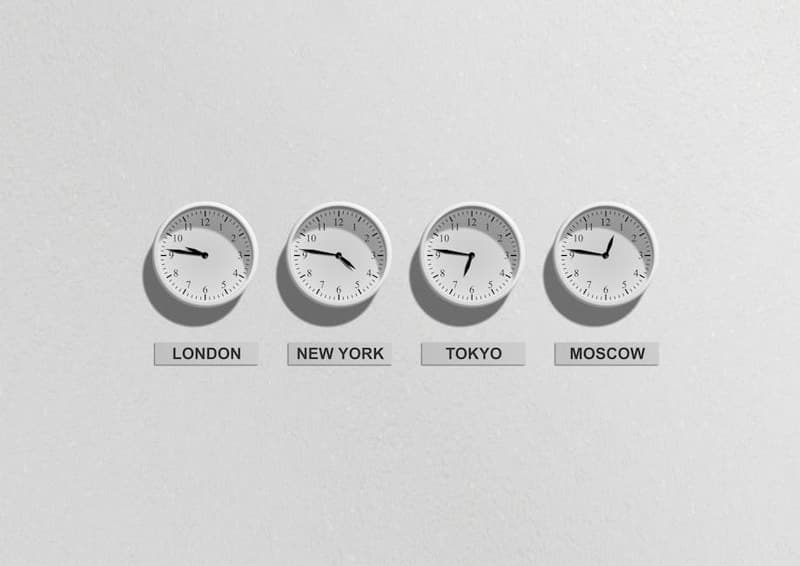
The difference between two cities is not a fixed number. It is the gap between two UTC offsets, and each offset is set by a government rule that can depend on the date. New York and Berlin are six hours apart for most of the year, five hours apart for three weeks in March, and five hours apart again for one week around the start of November. A meeting series that ignores this will put someone in the wrong call at least twice a year. All the examples below use specific 2026 dates, because without a date a time zone conversion is not fully defined.
Offsets, Zones and the Database Behind Them
Every civil time is written as an offset from UTC, the shared reference scale. New York in January is UTC-05:00; Berlin in January is UTC+01:00. To convert, subtract the source offset to reach UTC, then add the target offset. The difference between the two places is simply the target offset minus the source offset on that date.
The catch is in the words "on that date". Offsets are recorded as rules in the IANA Time Zone Database, often called tz or zoneinfo, which holds the history of local time for representative locations and is updated when governments change boundaries, offsets or daylight-saving rules. Most software receives those updates through the operating system or browser vendor. The database keeps changing: release 2026e, published on September 29, 2026, records Manitoba moving to a permanent UTC-05:00 from October 31, 2026. A device running older data will get times in such a region wrong until it is updated.
The Time Zone Converter uses the IANA rules built into your browser through its Intl interface. It asks for a date as well as a time, works out the offset each place uses on that day, and flags results that land on the previous or next calendar date.
Why the Gap Changes: Different Rules, Different Weekends
Three rule sets cover most of the scheduling headaches between North America, Europe and the South Pacific:
- United States. Under 15 U.S.C. § 260a, clocks advance at 2 a.m. on the second Sunday of March and return at 2 a.m. on the first Sunday of November. These dates have applied since 2007, after the Energy Policy Act of 2005 lengthened daylight saving time. Hawaii, Arizona (apart from the Navajo Nation), Puerto Rico, Guam, the US Virgin Islands and American Samoa do not observe it.
- European Union. All member states move clocks forward on the last Sunday in March and back on the last Sunday in October, on the same day at the same moment. London changes on the same Sundays.
- New Zealand. Daylight saving starts at 2 a.m. on the last Sunday in September and ends at 3 a.m. on the first Sunday in April, so New Zealand is on summer time while Europe and North America are on winter time.
Because the American and European dates differ, there are two mismatch windows each year. In 2026 the US changed on March 8 and Europe on March 29, and the Date Difference Calculator puts 21 days between those Sundays. In the autumn Europe falls back on October 25 and the US on November 1, a window of 7 days. During both windows, the transatlantic gap is one hour shorter than usual.
Example 1: A Weekly Call in the March Window
Carlos runs a supply-chain call from New York every Tuesday at 10:00 AM with a warehouse team in Berlin. Running each 2026 date through the converter gives:
| Date (Tuesday) | New York offset | Berlin offset | Berlin time | Gap |
|---|---|---|---|---|
| March 3 | UTC-05:00 | UTC+01:00 | 4:00 PM | 6 hours |
| March 10 | UTC-04:00 | UTC+01:00 | 3:00 PM | 5 hours |
| March 24 | UTC-04:00 | UTC+01:00 | 3:00 PM | 5 hours |
| March 31 | UTC-04:00 | UTC+02:00 | 4:00 PM | 6 hours |
Take March 10 step by step. New York is on daylight time, so 10:00 AM minus an offset of -4 hours is 14:00 UTC. Berlin is still on standard time at UTC+01:00, so the call starts at 15:00, or 3:00 PM, in Berlin. If the invitation was created in New York's calendar, the Berlin team sees it move an hour earlier for three Tuesdays and then move back. If the Berlin team blocks out 4:00 PM by habit, they miss the first half hour.
The fix is to decide which city owns the meeting time. A call anchored in New York shifts for the people in Berlin, and a call anchored in Berlin shifts for New York. Either is fine, as long as the people on the moving side know the dates in advance.
Example 2: The One-Week Gap in the Autumn
Priya leads a design team in London and holds a review with colleagues in New York every Tuesday at 4:00 PM London time. In 2026:
- October 20: London is on UTC+01:00 and New York on UTC-04:00, a 5-hour gap. The review starts at 11:00 AM in New York.
- October 27: London returned to UTC+00:00 on October 25, while New York stays on UTC-04:00 until November 1. The gap is 4 hours, and the review starts at 12:00 PM in New York, in the middle of a typical lunch break.
- November 3: both cities are on standard time, UTC+00:00 and UTC-05:00. The gap is back to 5 hours and the review is at 11:00 AM again.
Only one meeting is affected, which is exactly why it is easy to miss. A calendar entry with the time zone attached will move it correctly; a time copied into a chat message as "11 your time" will not.
Example 3: Opposite Seasons Between Auckland and London
Sam works in Auckland and has a standing call with a client in London at 8:00 AM on Tuesdays, Auckland time. Since New Zealand is far ahead of the UK, the London side of the call is always on Monday evening. The gap, though, takes three different values during 2026:
| Auckland (Tuesday, 8:00 AM) | London | Gap | Why |
|---|---|---|---|
| January 13 | Monday, January 12, 7:00 PM | 13 hours | Auckland on summer time, London on winter time |
| March 31 | Monday, March 30, 8:00 PM | 12 hours | Both on summer time |
| April 7 | Monday, April 6, 9:00 PM | 11 hours | Auckland on winter time, London on summer time |
| September 29 | Monday, September 28, 8:00 PM | 12 hours | Both on summer time |
| October 27 | Monday, October 26, 7:00 PM | 13 hours | Auckland on summer time, London on winter time |
Each clock change happens on a different weekend, so the London start time moves three times in the first half of the year: from 7:00 PM to 8:00 PM after Britain springs forward, then to 9:00 PM after New Zealand falls back. In September and October the steps run in reverse. For the client, the call drifts from early evening to late evening and back. For a team that rotates the inconvenient slot, the table shows when the rotation is due.
Calls that cross the date line need the date checked as carefully as the hour. "Tuesday morning" in Auckland is "Monday evening" in London, and a deadline of "end of Friday" means two different instants depending on whose Friday it is.
Working Days Are Local Too
Offices in different countries also lose different days to public holidays. For December 2026, the US Office of Personnel Management lists Friday, December 25 as the federal Christmas holiday. In England and Wales, GOV.UK lists Christmas Day on Friday, December 25 and, because December 26 falls on a Saturday, a substitute Boxing Day holiday on Monday, December 28.
Run December 1 to December 31, 2026 through the Working Days Calculator once per office. The month has 31 days, 8 of them weekend days. With December 25 entered as a holiday, the New York office has 22 working days. With December 25 and December 28 entered, the London office has 21. A joint deliverable estimated at 22 days of effort in both offices will run a day short in London unless the plan allows for it.
The calculator assumes a Saturday-Sunday weekend and counts both the start and end dates. For a team with a different weekend, count calendar days with the Date Difference Calculator and subtract the local rest days yourself.
Habits That Prevent Missed Calls
- Write the date, the time and the city. "Tuesday 10:00 AM New York" can be converted correctly on any date; "10 AM EST" is ambiguous in summer, when New York is actually on daylight time.
- Mark the mismatch windows. Add the four transition Sundays for each location your team uses to a shared calendar at the start of the year, and check each recurring meeting against them.
- Convert on the meeting date, not today. A conversion done in February for a call in late March can be an hour off. Put the actual meeting date into the Time Zone Converter.
- Keep the small hours of change nights free. On a spring-forward night some of those times do not exist, and on a fall-back night some happen twice.
- Keep devices updated. When a region changes its rules, as Manitoba did in the 2026e release, the change reaches calendars only through software updates.
Sources
- IANA Time Zone Database (iana.org)
- NIST: Daylight Saving Time (nist.gov)
- 15 U.S.C. § 260a, Advancement of time (Cornell LII) (law.cornell.edu)
- European Commission: The application of summertime in Europe (2014) (transport.ec.europa.eu)
- New Zealand Department of Internal Affairs: Daylight saving (dia.govt.nz)
- GOV.UK: UK bank holidays (gov.uk)
- US Office of Personnel Management: Federal holidays (opm.gov)