Kitchen Conversions: Cups, Grams, Spoons and Scaling Recipes
By the MeasureMate team · Published · Updated
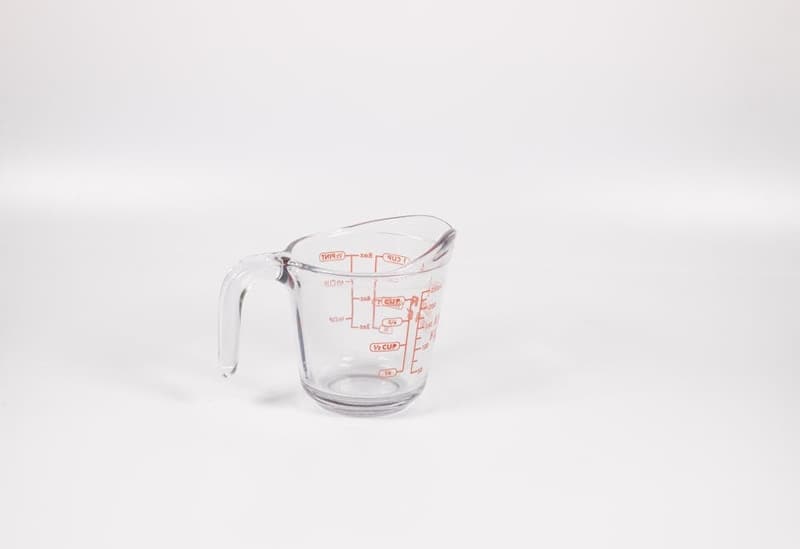
Kitchen conversions come in two kinds. Converting one volume to another, such as tablespoons to milliliters, is exact arithmetic, because every US kitchen unit is a fixed fraction of the gallon. Converting a volume to a weight, such as cups of flour to grams, depends on the ingredient: a cup of honey weighs about four times as much as a cup of cocoa. Most recipe mistakes come from treating the second kind as if it were the first.
The US kitchen units, defined exactly
The US gallon is defined as 231 cubic inches, and the inch is exactly 2.54 cm, so the gallon works out to 3,785.411784 mL. Everything smaller is a division of it: a quart is a quarter, a pint an eighth, a cup a sixteenth, a fluid ounce 1/128, a tablespoon 1/256 and a teaspoon 1/768. The cooking conversion calculator stores the units that way, which gives these values:
| Unit | Exact size | Equivalent |
|---|---|---|
| Teaspoon | 4.93 mL | 1/3 tablespoon |
| Tablespoon | 14.79 mL | 3 teaspoons |
| Fluid ounce | 29.57 mL | 2 tablespoons |
| Cup | 236.59 mL | 16 tablespoons, 8 fl oz |
| Pint | 473.18 mL | 2 cups |
| Quart | 946.35 mL | 4 cups |
| Gallon | 3.785 L | 16 cups |
NIST's own kitchen equivalency table rounds these to friendlier numbers (5 mL, 15 mL, 240 mL for a cup) and marks them as approximate. For cooking the rounding never matters; a 3 mL difference in a cup of stock disappears in the pot.
Where trouble starts is that the same names mean different things in other countries. A metric cup is 250 mL, which the calculator puts at 1.057 US cups, roughly 6% more. NIST notes that metric cups and spoons are slightly larger than US ones and can often be swapped in home cooking. The British imperial pint is a bigger step: it holds about 568 mL against the US pint's 473, because the imperial gallon is a different, larger unit. A recipe that says "pint" without saying whose deserves a second look.
Why a cup of flour has no single weight
Grams measure mass, cups measure space, and ingredients fill space differently. The converter holds a grams-per-cup figure for each ingredient it lists. For one level US cup it gives:
| Ingredient | Grams per cup |
|---|---|
| Rolled oats | 81 g |
| Cocoa powder (unsweetened) | 86 g |
| All-purpose flour | 125 g |
| Granulated sugar | 200 g |
| Brown sugar (packed) | 220 g |
| Butter | 227 g |
| Whole milk | 244 g |
| Honey | 339 g |
These are averages for a cup filled the usual way. Flour is the soft spot: spooned loosely into the cup and leveled, it lands near the table value, while a cup scooped straight from the bag compacts it and holds more. Brown sugar is listed packed because recipes almost always ask for it pressed down. NIST calls weighing ingredients on a kitchen scale the better practice for accuracy, and recommends a different tool for each job: dry cups filled and struck off level, and a clear liquid cup set on the counter and read at eye level at the bottom of the meniscus. Using a dry cup for liquids, or the reverse, is one of the errors NIST singles out.
Converting a metric recipe to cups
Grace has a family lemon cake recipe from a relative in Ireland: 400 g flour, 250 g caster sugar, 300 mL milk, baked at 180 °C. She has US cups and an oven marked in Fahrenheit, but no scale.
- Flour. At 125 g per cup, 400 g ÷ 125 = 3.2 cups. That is 3 cups plus a fifth of a cup, or 3 cups and a little over 3 tablespoons.
- Sugar. Caster sugar is not in the converter's list, so Grace uses granulated, its nearest entry. At 200 g per cup, 250 g is 1.25 cups, which is 1 1/4 cups.
- Milk. This is a pure volume conversion: 300 mL ÷ 236.59 = 1.27 cups. Fill to the 1 1/4 cup line and add a splash.
- Oven. The temperature converter turns 180 °C into 356 °F. Nobody bakes at 356 °F; NIST's oven table pairs 180 °C with 350 °F, so she sets 350 °F.
The flour step is the one most likely to drift. If her 3.2 cups were packed rather than spooned, the cake would carry noticeably more flour than her relative intended. A basic scale removes that guess entirely, and the weight converter handles any ounces or pounds in older recipes.
Scaling a recipe up
Tomás has a skillet cornbread that serves 4 and needs it for 10. The recipe converter divides desired servings by original servings to get one factor and applies it to every line: 10 ÷ 4 = 2.5.
- 1.5 cups flour × 2.5 = 3.75 cups. In the cooking converter that is 469 g, so with a scale he weighs it instead of counting cup after cup.
- 3 eggs × 2.5 = 7.5 eggs. Round to 7 or 8, or beat the eighth egg and add half of it.
- 2 tablespoons sugar × 2.5 = 5 tablespoons, which is 1/4 cup plus 1 tablespoon.
The arithmetic is the easy part. The batter now needs a bigger pan or two of the original size, and a deeper layer bakes differently from a thin one, so the recipe's time is a minimum to check against, not a number to multiply. Salt and strong spices are worth adding gradually, tasting as the batch comes together.
Halving a recipe
Sam's cookie recipe makes 24, and he wants 12. The factor is 12 ÷ 24 = 0.5, and halving turns friendly fractions into awkward ones.
- 3/4 cup packed brown sugar becomes 0.375 cups. No cup in a standard set measures 3/8, but the converter shows it equals 6 tablespoons, or 82.5 g on a scale.
- 1 cup butter becomes 1/2 cup, which the converter weighs at 113.5 g. A quarter pound is 113.4 g, so a recipe calling for 1/2 cup of butter and one calling for 4 oz are asking for the same amount.
- 1 egg becomes half an egg. Beat it, weigh it, and use half the weight.
Converting down to tablespoons, or straight to grams, is usually cleaner than hunting for fractional cups. For larger volume jumps, such as quarts of stock to liters, the volume converter covers units beyond the kitchen set.
Oven temperatures and thermometers
Recipes rarely need exact Fahrenheit-to-Celsius results, because ovens are set in steps. Going the other way, 350 °F converts to 176.67 °C, which European recipes write as 180 °C. NIST's culinary temperature table groups old recipe wording with modern settings: "moderate" covers 180 °C to 190 °C, or 350 °F to 375 °F, and "hot" covers 200 °C to 230 °C, or 400 °F to 450 °F.
NIST also points out that ovens of the same model can run at different temperatures. A dial reading is a request, not a measurement. An oven thermometer shows what the oven actually delivers, and a cooking thermometer can be checked in boiling water, which reads 100 °C at sea level; any difference is the correction to apply to later readings.
Which conversions are safe to estimate
Volume-to-volume conversions can be rounded freely for everyday cooking: a tablespoon as 15 mL, a cup as 240 mL. Weight-to-weight ones are just as safe, since an ounce is fixed at about 28.35 g. The conversions that deserve care are volume to weight for dry baking ingredients, where how the cup was filled changes the answer, and recipes from other countries that use the same unit names for different sizes. In both cases the reliable fix is the one NIST suggests for converting an American recipe: measure it once the traditional way, weigh what you measured, and write the grams on the recipe card.
Sources
- NIST Office of Weights and Measures: Culinary Measurement Tips (nist.gov)
- NIST Handbook 44, Appendix C: General Tables of Units of Measurement (nist.gov)
- NIST Special Publication 430: Household Weights and Measures (approximate weight of a cup of common ingredients) (nist.gov)
- NIST Metric Kitchen: Cooking Measurement Equivalencies (nist.gov)
- NIST Metric Kitchen: Culinary Temperature (oven temperature equivalents) (nist.gov)